Every amateur team has tried to build a stratbook. The Google Doc from two rosters ago. The forty Discord pins nobody scrolls back to. The YouTube video of nade clips that are outdated after the next update. Making a stratbook has never been the problem. Creating one your team wants to use, that's the real struggle!
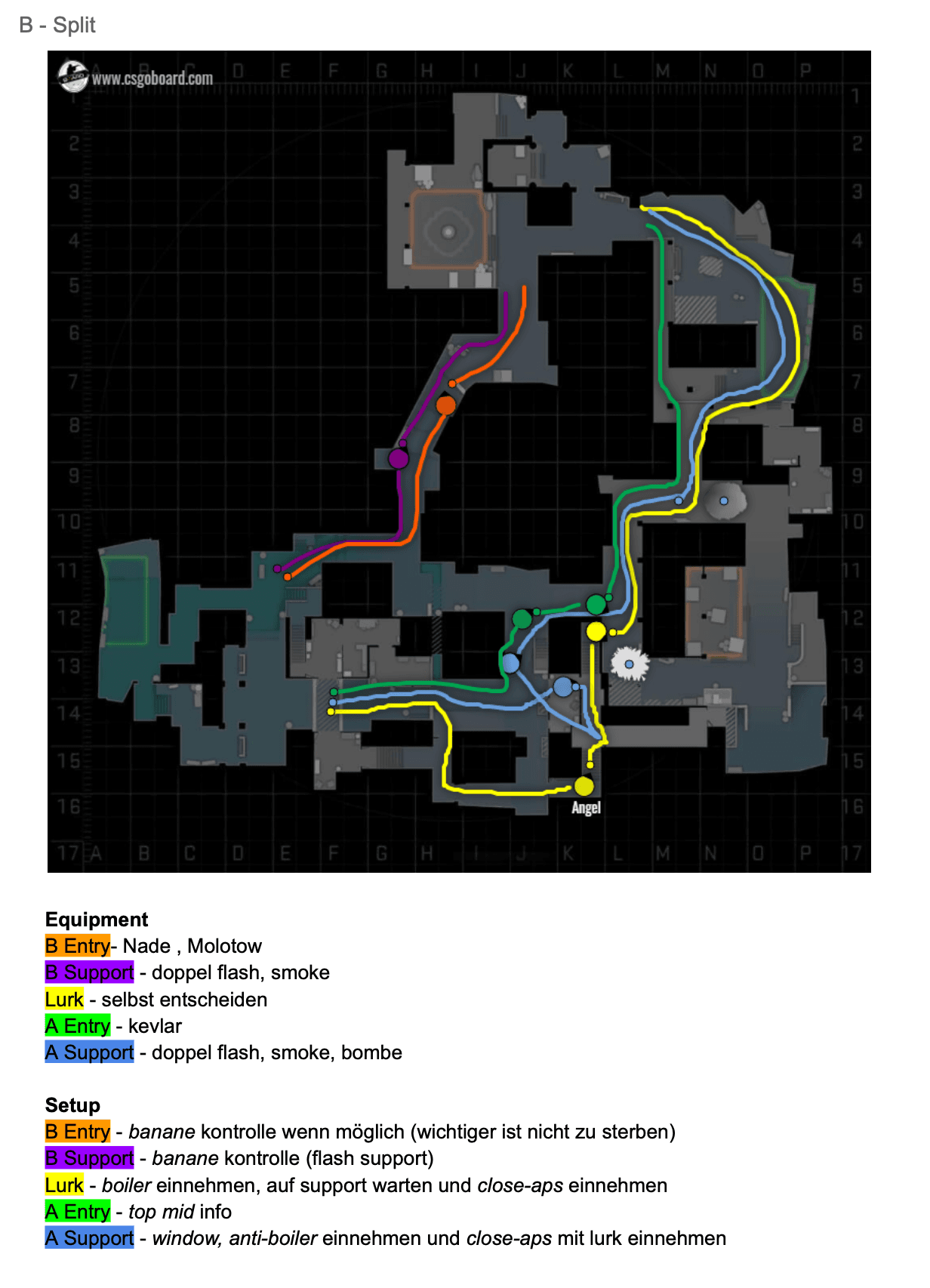
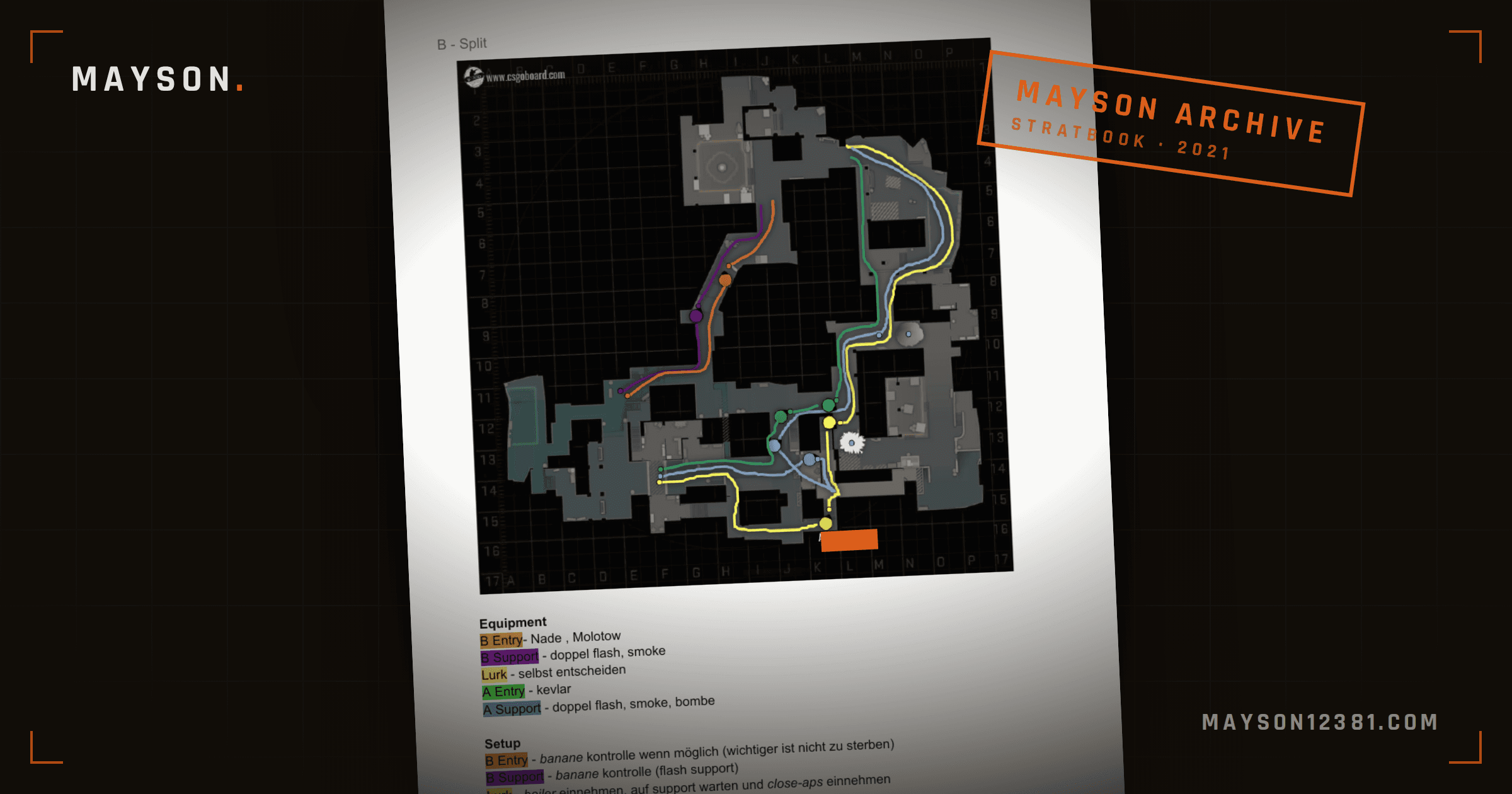
I've been through every version of this. My first team, back in CS:GO around 2021, had a Google Doc: role table, defaults for every player, each strat broken into equipment, setup, and execute. Everyone had a link, though only the IGL really used it... My next team's stratbook, a year later? Almost pure map diagrams. Almost no player instructions. Not because we knew less, but because I had learned how brutal it is to maintain the detailed version, and the book quietly shrank until it was just a few pictures and instructions. We dragged it along, half-outdated, until the team itself ended. That's how stratbooks actually die: not deleted, just slowly abandoned, because they are annoying to maintain.
A stratbook that gets used is not a document. It's a routine with a home. This guide covers what goes in it, what to leave out, how to structure it so you can find your job mid-scrim, and how to keep it alive past week three.
Why most stratbooks die in three weeks
Three killers, and every dead stratbook I've seen was hit by at least one of them.
Write-only syndrome. Information goes in once when the IGL writes it, but nothing is ever updated after a scrim. If the book isn't open during prac and on matchday, it's a time consuming diary, not a tool. Our early books had exactly this problem: even when you found the right strat mid-round, you couldn't find the one line that told you what to do. Five paragraphs of team instructions are worthless when the freeze timer is at fifteen seconds and you just need your own instruction. Don't forget at the same time you need to listen to the IGL and pick the correct equipment and gear to buy.
The completeness trap. Teams try to document all seven maps, every nade, every default, in week one. They burn out by map three, and the half-finished book feels like a graveyard, so nobody touches it.
The one-owner problem. The IGL builds it, the IGL maintains it, the IGL burns out, the book dies. Later on, one of my teams tried to fix this with "homework": everyone was assigned strats to type into the spreadsheet and blanks to fill in. It worked, a bit. It was also perceived as annoying, and hated homework produces stale data. Strats got forgotten, details changed and nobody updated them.
Everything in the rest of this guide is a countermeasure to one of these three.
What actually belongs in a stratbook
A stratbook should not be a never ending list of everything your teams need. It's mainly a decision-support tool for freeze time and a helping hand during scrims or practice. Strat names your IGL can quickly call. Here is what your core should include:
Defaults, per map. Your T-side and CT-side baseline. This is what everyone does when nothing is called. This is half the value of the whole book, and most teams skip it because it feels too obvious to write down.
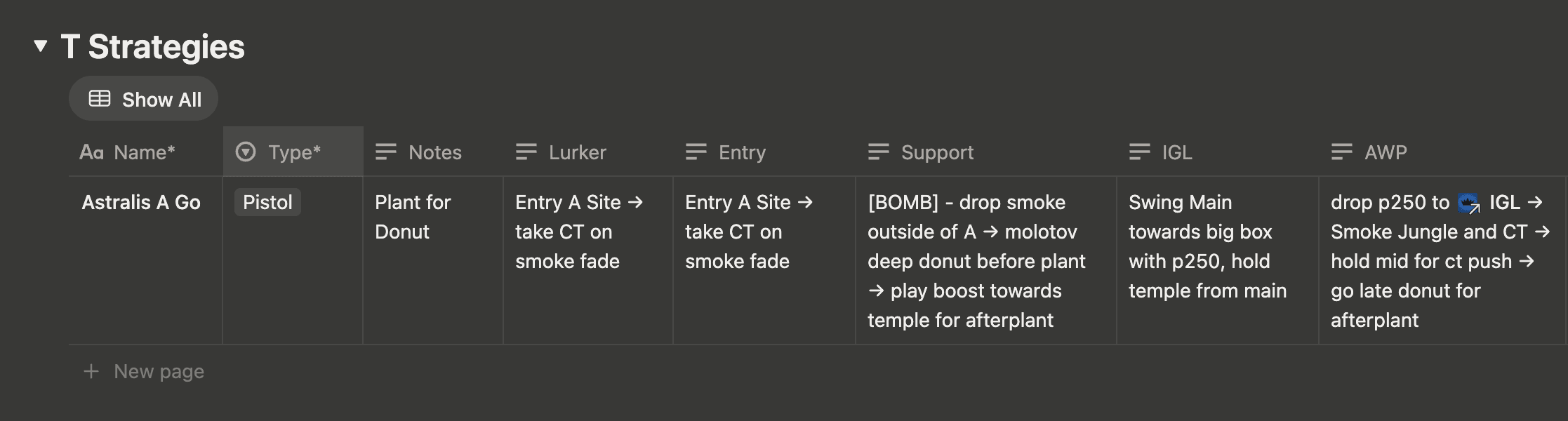
Set strats with names. Three to five per map that everyone can execute blind are better than fifteen that need a re-explanation every time. (You'll grow beyond five eventually, but you earn that by mastering the first three, not by writing all fifteen in week one.) Each entry needs the same things: a title, the utility it requires, roles per player, and a team instruction, for example when you'd call it.
Here's what a complete entry looks like. This is a real one, in the format I use today:
Utility lineups, linked to strats, not a flat dump of 200 nade clips. A lineup with no context is trivia.
Opponent notes. A light document about your next opponent that is written before each match. (Full anti-strat guide coming in a future post.)
A practice log for each player. What mistake did you make, what broke, what to fix next time. This is what turns the book from storage into a feedback loop.
And what to leave out: aim routines, general CS theory. The stratbook is the team's shared brain, not everyone's private notebook. (Personal notes belong in the book, but on your own page. More on that in a second, because it's the single most important structural decision.)
Structure: organize by decision, not by category
The classic mistake is organizing a stratbook like a wiki: Maps → Nades → Strats → Misc. Wikis are for reading. Stratbooks are for finding one thing in ten seconds while the bomb timer runs.
I rebuilt mine four times: Google Doc, then another Doc, then Google Sheets, then Notion, and every rebuild was chasing the same two failures. Sheets got me to one page per map, which genuinely helped. But there was still endless scrolling, and still the original sin: I could find the strat, but not my instruction in it.
So here's the principle every good structure follows, and the one most tool pages won't tell you: a stratbook has to answer "what do I do?" faster than "what do we do?" Five people asking "what's my job" is what a live round actually looks like. Your stratbook should aim to solve this job.
One page per map, with T-side and CT-side clearly separated. Everything for that map lives there: defaults, strats, lineups. No hunting across sections mid-game.
At a glance: the strat name, your personal instruction, and the one team-wide instruction everyone shares. Everything else: full utility details, alternative reads are one click deeper, not on the surface.
And this is what most Stratbooks don't have:
Every player gets their own page.
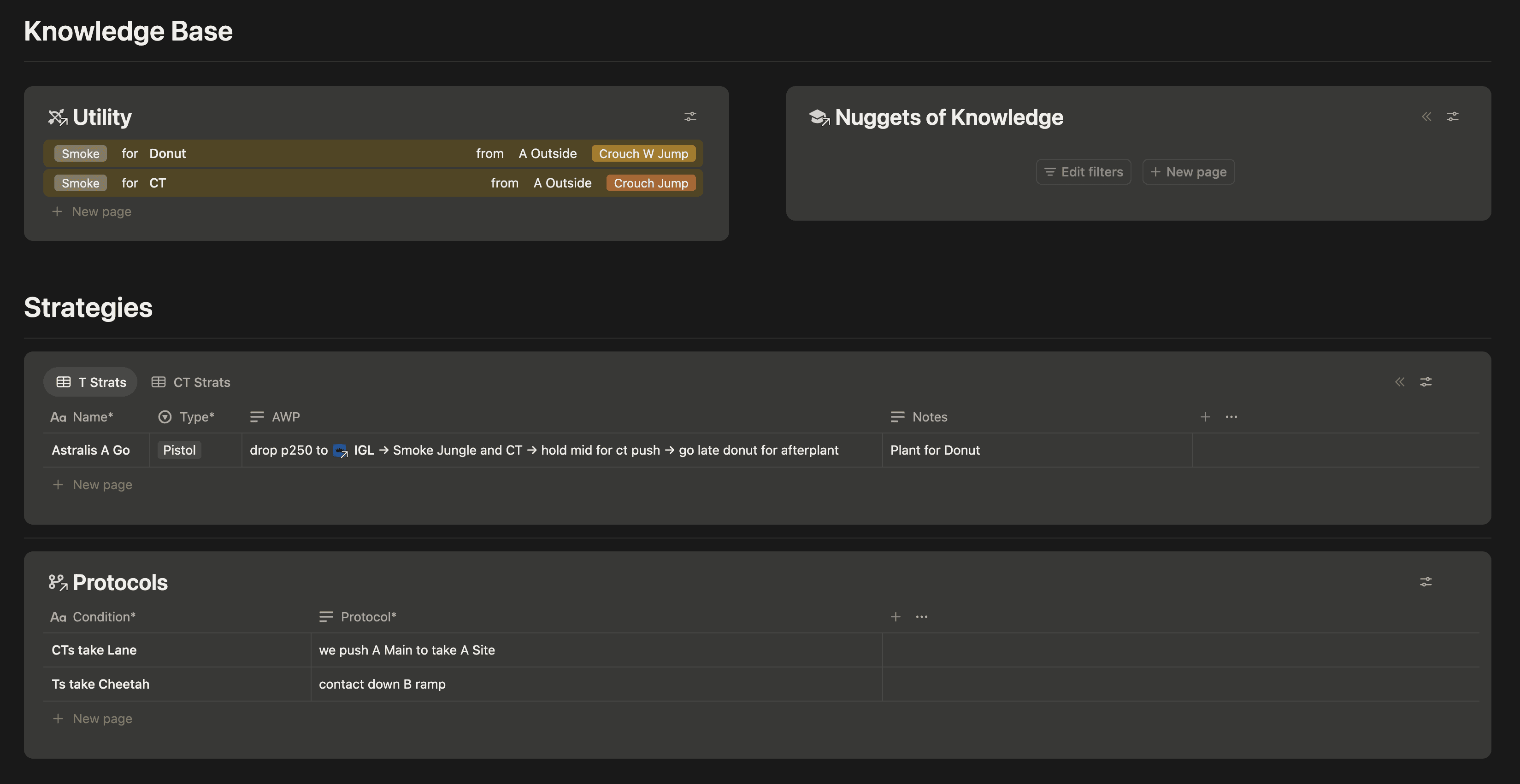
Every player gets their own page. Their notes, their learnings, their to-dos, their utility, and the strats filtered to their role. All organized so it's actually accessible during a match. This is the single most important change that made my teammates open the book voluntarily. A stratbook that shows you the info you need most is a powerful tool.
Tag strats by side, buy level, and situation (pistol / force / full-buy, opening vs. mid-round) so they can be sorted dynamically.
Same layout for every entry. Consistency is what makes it scannable under pressure. Title, type, utility, instructions, in that order, every time.
One "start here" dashboard: next match, this week's practice focus, the three newest changes. This is the page that gets opened on Tuesday.
The tool question: Docs, an app, or Notion?
Here lies the most difficult task, what tool should pick for this job.
Honest answers, because I've lived most of them.
Google Docs and Sheets are free and everyone knows them. A Doc is fine for a pure nade list and falls apart the moment you need structure. That's how you end up with strats_final_v3 and a PDF export nobody updates. Sheets are better: you get one page per map and some order. But you'll scroll forever, and per-player views basically don't exist.
Dedicated stratbook apps (stratbook.pro, SCL's playbook, Stratbase) are purpose-built, with map tools included. The trade-offs are real, though: most run on subscriptions for the good features, your strats live inside their system in their format, and you get their structure whether it fits your team or not. If the app shuts down or you stop paying, years of team knowledge don't come with you.
Notion is where I landed after the fourth rebuild. The free tier is enough for a full team, the structure above maps onto it naturally, formatting and structure blogs are built in, and it's editable on the fly mid-scrim, which matters more than any feature list. The honest downside: a blank Notion page is a blank page. You're building the structure yourself, and that's weeks of work.
That is exactly why I made a free starter: the Free Stratbook has a page for every map with basic strategy sections. The per-player pages and practice log are only in the paid version, but it's enough to find out if your team would actually open it. Duplicate it, run one practice with it, and you'll know.
The rollout: getting five people to actually use it
This is the part nobody writes about, and it's the reason "actually use" is in the title. The structure gets you findability of a strat; the rollout gets you the habit.
Start with one map. Your best map, fully done: defaults, three named strats, linked utility. Ship it to the team before touching map two. This is the countermeasure to the completeness trap.
Teach everyone how to use Notion. Show them how it's best used and they will start using it themselves. Spend fifteen minutes in your first team meeting showing everyone their personal page, and let each player fill in their own utility. I usually open the stratbook in my Steam Overlay, that way I don't need to tab out or have a second monitor open.
Give notion a slot in the routine. Five minutes at the start of practice: open the dashboard, review what changed. Five minutes after: log what broke. If it's not in Notion, it doesn't exist.
Read from it, live. The real difference between my spreadsheet era and now isn't the tool, it's that the book finally earned a place on the second monitor or in the Steam overlay. I have it open in every scrim, every official, every demo review. The first time your IGL makes a mid-half adjustment straight from the strategy page, the stratbook stops feeling like homework and becomes a weapon. That moment is the finish line of this guide.
If you'd rather skip the structural work entirely: the Free Stratbook covers every map with basic strategy sections. The CS2 Stratbook ($20) is the full per-map system, and the Ultimate CS2 Playbook ($50) adds scrim reviews, VOD analysis, and roster management on top. Everything in this post, already built, one-click duplicate, runs on Notion's free tier, yours forever. No subscription, because your stratbook shouldn't die when you stop paying for it.