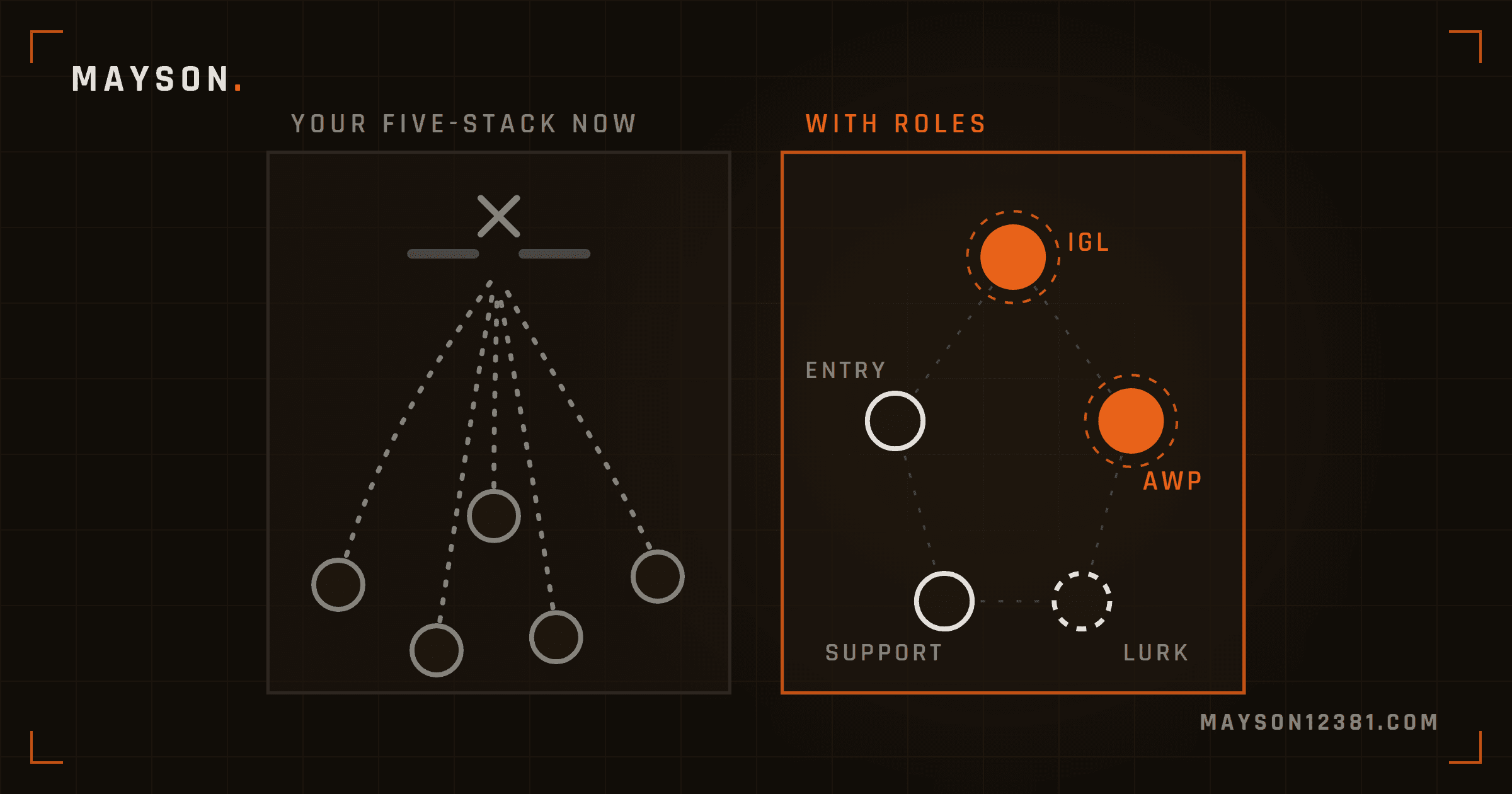
Every pro roster has an IGL, an AWPer, an entry, a support, and a lurker. Most five-stacks have five riflers who all want to peek first. You have probably lived the result: one guy dry-peeks, dies, and the other four wait in ramp. Someone on Reddit described it as "everyone peeks one by one and dies in a 1v4". That is the actual starting point of most amateur teams, and it is why copying the pro role list onto your friend group does not work.
This guide is about the decision nobody writes about: how five real people, with real egos and one shared Discord, figure out who plays what. Not what an entry fragger does at a Major. Who on YOUR team should do it.
After three teams of my own, my answer is simple: assign two roles and let the other three form on their own. The IGL and the AWPer need to be decided, and once decided you should not switch them. Entry, support, and lurker sort themselves out over time, as long as nobody already feels strongly about a role. And those three can switch later without breaking anything.
Do roles even matter at your level?
Ask this question on r/LearnCSGO and the top answer is usually some version of "don't". "There no roles in pugs" is a real quote. So is "keep roleplaying out of pugs", from a Faceit level 10. One player even argues you need nothing of this below level 10.
They are half right, and it is worth being honest about which half.
The "roles don't matter" crowd is talking about pugs and matchmaking, where you play with randoms and the spawns decide who does what. They are correct about that. If your five-stack queues Premier twice a week for fun, you do not need a role sheet. You need aim and a good mood.
But the moment you become a team, playing pracs, scrims, or a league season against other teams that prepare, the calculation flips. A strat only works if everyone knows their job in it. An execute where nobody knows who entries first is just five people walking into a smoke. And two decisions cannot wait for things to sort themselves out: someone has to call, and someone has to carry the AWP. Everything else in this post follows from that split.
The five roles in 90 seconds
Quick definitions so we are talking about the same things. If you know these, skip ahead.
IGL (in-game leader). Decides the buy, calls the plan, makes the mid-round call when the plan dies. The team's external brain.
AWPer. Carries the $4,750 gun and the responsibility that comes with it. Holds angles on CT, takes picks on T. The economy bends around this player.
Entry. First through the door on executes. Takes the fight so the second player can trade. Dies a lot, by design.
Support. Throws the flashes the entry runs out on, holds the flank, plays the boring positions. At amateur level this is less a personality and more a set of habits: trading, playing your life, crossfires.
Lurker / anchor. On T side the lurker plays away from the pack, punishing rotations. On CT side an anchor holds a site alone. Both need discipline, because the failure mode is the same: a teammate "lurking" in the back while four die.
That is the pro framing. Now the two roles you actually have to assign.
Who should IGL?
The default in most friend groups: the highest-ranked player gets the job pushed onto them. A 24k Premier player playing with 9k-17k friends wrote: "naturally they expect me to kind of be the leader... But I'm horrible at leading." That is the most common IGL origin story in amateur CS, and it is the wrong logic. Rank measures fragging. IGLing is a different skill.
The right question is not who frags best. It is who knows the most about the game. Your IGL should be the player who understands the most of what is happening in and off the server: timings, economy, what the enemy is probably doing, what your own team should do about it. In my experience that is always the same person who invests the most time in the game outside of playing it. Watching demos, thinking about strats, reading about the game. The knowledge and the time investment come as a package.
In my first team I ended up calling for exactly that reason. Nobody knew more about the game at the time, so the job was mine. Not because I had the best aim, and not because anyone voted.
There is a second part, and I think it matters more than any trait list: real IGLs feel a calling for it. The people who end up being good callers wanted the job, even if they never said it out loud. The ones who get forced into it because nobody else wants to talk will ultimately fail. You see this all over Reddit: "when I try to IGL it's like my brain just can't handle all the info" is one of the most repeated complaints in amateur CS, and it almost always comes from someone who got the job by default. A reluctant IGL is not a role assignment, it is a countdown.
One more thing worth knowing before you hand someone the job: IGLing costs frags. Karrigan's rating is the community's running joke about it, and it is just as real in your league division. The caller watches the minimap, checks flanks, dies for information. If the candidate's mood depends on their K/D, they will hate the job. The interesting exception: some players actually frag better when they call, because they set up the rounds around themselves. If someone on your team lights up when they get to direct, that is the calling showing itself.
And separate the IGL from the team founder if they are not the same person. Plenty of teams have a founder who made the Discord and an IGL who calls the rounds. The two jobs are not the same, and if you never decide who has the final call in-game, you will decide it mid-argument in round 20.
Who should AWP?
The oldest fight in amateur CS. One community-team IGL described his tryouts: "everybody wants to AWP or Entry Frag... at one point we had 3 AWPs on T side inferno." That post is from 2016. The identical thread reappears every year, because the underlying problem never changes: one gun, several egos.
Here is what I have seen instead, across my own teams: the real AWPer announces themselves. Like IGLing, AWPing is a calling. The player who is meant to carry the gun keeps gravitating back to it, and once they have the role they tend to stay in it forever. I know because I lived it from both sides. I started as an IGL, then felt the pull toward the AWP, switched roles in my third team, and never went back to calling. I have been the AWPer ever since.
So when you assign the role, you are mostly confirming something. The practical rules for confirming the right person:
Consistency beats highlights. You want the player who hits the shots they should hit, not the one with the occasional flick clip. One amateur AWPer on Reddit told the story of giving up the role himself after a teammate pointed out he was more aggressive but less consistent. They switched. It worked.
The team funds the gun, so the team confirms the player. The AWPer's economy is a team project: someone drops, someone saves, someone buys armor without a helmet so the AWP comes out a round earlier. That only feels fair if the team stands behind the choice. The guy who insists on AWPing but never gets dropped for is a recurring character in team drama threads for a reason.
If nobody feels the pull, don't force it. A team without a natural AWPer is better off sharing the gun by spawn and situation than appointing someone who does not want the responsibility. In CS2 this is more viable than it was in CSGO, because random spawns move the AWP position around anyway. But watch what happens over a few months: usually someone starts reaching for the gun more and more. That is your AWPer.
The one thing you should not do is leave it contested. Contested means three AWPs on T side Inferno.
Why you shouldn't switch your IGL or AWPer later
The other three roles are cheap to change. If your entry turns out to enjoy lurking, switch it next prac and nothing breaks. IGL and AWP are different, and my opinion is that once assigned, you should not switch them at all.
The reasons are structural. The whole team's habits form around the caller: how rounds start, who speaks when, what the mid-round sounds like. Replace the IGL and you reset months of that. The AWP is the same through the economy: buy patterns, drop habits, who plays which angle, entire CT setups are built around where the AWP stands. These two roles are load-bearing. Entry, support, and lurker are furniture you can move.
If you do feel a switch coming, the honest version is what happened to me: I did not hand over the AWP within a team, I changed roles when I changed teams. A new team is a reset anyway. Within a running team, switching the caller or the AWPer mid-season is the kind of decision that looks small and costs you two months.
The same logic answers a question that comes up constantly: can the IGL also AWP? Some try it. I think it is not the best combination. It can work, but it is always better to have a dedicated caller. Calling and AWPing both eat attention, and mid-round is exactly when you need both at once.
Entry, support, lurker: the roles that form themselves
For the other three, my advice is to do less than the role guides tell you. As long as nobody arrives already feeling like an entry or a lurker, these roles form naturally out of how people play. Your job is just to notice them, name them, and respect the switch requests. What I have seen with each:
Entry: your second-best aimer, not your best. This folk rule has survived a decade of Reddit threads because it is correct. The entry's job is to take a fight that gets traded. Your best aimer is more valuable as the second player, shooting the now-exposed defender, than as the first body through the door. What the entry really needs is not aim, it is willingness. Someone has to genuinely not mind dying for the team's information.
Support is habits, not a punishment. In CS nobody fights over support the way they fight over the AWP, but nobody volunteers either. Reframe it: support is not "the leftover player", it is the player with the best utility knowledge and the discipline to trade. A self-described support main put it plainly: good trades, playing life, and crossfires are not some big secret, people just get lazy with them. On a team of five friends, give support to the player who already buys nades in pugs. You know who it is.
The lurker needs a license. The difference between a lurker and a baiter is whether the team agreed to it. If one of you naturally drifts away from the pack, make it official: on T side, this player lurks, and the IGL uses that. If it is not official, you get the oldest complaint in Counter-Strike: "Oh, we were lurking", said by the last player alive.
Anchors only work with a team in front of them. Solo queue players learn that anchoring is a trap: you hold B alone, your team gets rushed elsewhere, and you are useless. In a real team it is the opposite. A fixed anchor who knows their site, round after round, is one of the cheapest wins available, because most amateur CT sides just play whatever spawn they got. Deciding "you anchor B on Mirage, every round, regardless of spawn" is the kind of unglamorous decision that wins pistol rounds.
One more thing the pro guides skip: assign your CT side too. Amateur teams put all their role energy into T side and then play CT by spawn. Your CT setup is five roles as well: two anchors, a mid player, a rotator, an AWP position. It goes in the stratbook next to the strats.
And keep all three loose. In modern CS roles are fluid anyway. Look at how experienced amateur players advertise themselves in team-search posts: "IGL/any other role and AWP/anchor". Hybrid, side-specific, flexible. The point of naming the roles is not to lock people in. It is so that in the middle of an execute, everyone knows whose job is what.
The three ways role assignment goes wrong
Assigning too much, too early. One ex-IGL tells the story of his 2014 team: they assigned strict roles at an average level, and the result was passive teammates who waited for calls and an IGL who never learned to improvise. If your whole team is still working on aim and utility, a full pro-style role system is a straitjacket. An IGL, an AWP agreement, and positions per map is plenty for the first months.
The top-down decree. A new IGL assigns everyone a role, teaches default utility, explains comms, and then wonders why nothing sticks. The most upvoted reply to exactly this story: comms and coordination are a group project, not something dictated. Roles that formed naturally hold up under pressure. Roles that were handed down get quietly ignored around round 16.
Forcing the two roles that need a calling. The forced IGL fails slowly, then all at once. The forced AWPer wastes $4,750 a round on a job they never wanted. If neither role has a natural owner yet, run flatter for a while and let the game tell you. It will.
Write it down
Whatever you decide, it lives or dies on whether it is written down. Not because your five friends will forget who AWPs, but because the details rot: who anchors B on Mirage, who lurks on Inferno T side, what the entry expects flashed on the A execute. Three weeks after the conversation, everyone remembers a slightly different version.
The format does not need to be fancy. One page per player: their positions per map on both sides, their job on executes, their buy priorities. Per map, a positions table showing who plays where. When a role changes after a prac, the page changes the same evening.
This is exactly the structure The Ultimate CS2 Playbook uses: a roster where every player has their own page, linked to the maps and strats they appear in. If you want to start smaller, The Free Stratbook gives you the per-map structure and you can add a simple roles page yourself.